
Working for You in Washington: Neurosurgery Making a Difference
Through advocacy, policy development and public relations, the AANS/CNS Washington Committee and Washington Office have played a fundamental role in advancing neurosurgery’s legislative and regulatory agenda. Throughout the year, the Washington Office staff are in the halls of Congress or working with government agencies and other health care stakeholders advocating on behalf of neurosurgery. In this role, the AANS frequently interacts with members of Congress, the Centers for Medicare & Medicaid Services (CMS), the Food and Drug Administration (FDA), third-party payers and state and national medical associations. And while the COVID-19 pandemic threw us a curveball, AANS advocacy continued unabated, with organized neurosurgery achieving a variety of successes.

AANS leaders past and present in the White House Press Briefing Room
COVID-19 and the Global Pandemic
On March 13, the president issued an executive order declaring the COVID-19 pandemic a national emergency. Shortly after that, neurosurgical practices began temporarily suspending non-emergent neurosurgical cases and experiencing significant cash-flow challenges. Working with multiple coalitions of physician organizations in Washington, D.C., the AANS stepped into high gear to advocate for financial and other relief for neurosurgeons.
Congress passed several COVID-19-related bills, which included vital assistance for physicians and hospitals. The Coronavirus Aid, Relief, and Economic Security (CARES) Act (H.R. 748) and the Paycheck Protection Program and Health Care Enhancement Act (H.R. 266), established and funded the Paycheck Protection Program (PPP), allowing neurosurgical practices to receive grants to help keep their employees paid and their practices afloat. The legislation also allocated $175 billion to the Public Health and Social Services Emergency Fund, helping with bridge funding for neurosurgeons and the hospitals in which they practice. The Medicare sequester, which reduces payments to providers by 2%, was also temporarily halted, and neurosurgeons were allowed to apply for advanced payments under Medicare’s Accelerated and Advance Payment (AAP) Programs. The expansion of telemedicine, and increased payments for telemedicine services, helped neurosurgeons continue to take care of their patients remotely and will likely be an integral part of neurosurgical practices in the future. Finally, the AANS led efforts to secure COVID-19-related medical liability protections. The CARES act included provided liability protections for physicians rendering volunteer medical services during the COVID-19 public health emergency. In addition, Reps. Phil Roe, MD, (R-Tenn.) and Lou Correa (D-Calif.) introduced H.R. 7059, the Coronavirus Provider Protection Act, which would provide physicians protections from COVID-19-related lawsuits.

NeurosurgeryPAC vice-chair, Stephen S. Scibelli, MD, FAANS, with Sen. Rick Scott (R-Fla.)
To tell neurosurgery’s COVID-19 story, the AANS/CNS Neurosurgery Blog launched a blog series, covering a wide variety of topics related to the pandemic over nearly two-dozen posts. On the blog’s pages, neurosurgeons from across the country told their stories about the global impact of the COVID-19 pandemic.
The AANS COVID-19 Information Hub includes a compilation of the Washington Committee’s advocacy activities related to the pandemic.

Improving the Nation’s Health Care System
The AANS advocated for improvements in the nation’s health care system, including expanding access to affordable health insurance coverage for every American, enhancing patients’ choice of insurance plans and providers and maintaining reforms that redress several inexcusable insurance practices — such as high-deductibles, narrow provider networks and prior authorization requirements.
- Given the growing concern over the practice of unanticipated medical bills — driven mainly by narrow insurance networks — leaving some patients on the hook with the bill if they receive care from an out-of-network provider, eliminating surprise medical bills is a top priority for neurosurgery. To this end, the AANS has been instrumental in leading the charge to get legislation passed. Due to this advocacy, the Protecting People from Surprise Medical Bills Act (H.R. 3502) was introduced in the House of Representatives. Also supported by neurosurgery, the Stopping The Outrageous Practice of Surprise Medical Bills Act (S. 1531) is gaining momentum and is serving as the basis of a final compromise agreement. These bills reflect neurosurgery’s principles on out-of-network care and strike the right balance to protect patients from unanticipated medical bills, while at the same time facilitating a process to quickly, efficiently and fairly resolve physician and health plan billing disputes.
- According to a recent national survey of neurosurgeons, approximately two-thirds of respondents do not support a single-payer, government-sponsored health insurance system. Recognizing that millions of Americans have no health insurance, the AANS continued advocating for a system that builds on and makes improvements to the existing pluralistic system, which includes employer-based coverage, Medicare for those currently eligible, state-based programs such as Medicaid and other those supported by the Affordable Care Act. To expand our voice in this critical debate, the AANS joined the Partnership for America’s Health Care Future, a coalition of the nation’s leading doctors, nurses, clinicians, community hospitals, health insurance providers, and biopharmaceutical companies.

Champion Fair Reimbursement
To ensure access to vital neurosurgical services, Medicare must maintain 10- and 90-day global surgery payments, and CMS must not use flawed or incomplete data from the global surgery code data collection initiative to revalue global surgery codes. Due to the advocacy efforts of the AANS, no significant changes in global surgery fees in 2020 were forthcoming and preventing these cuts saved approximately $175,000 per neurosurgeon each year from 2018 through 2020.

AANS/CNS Washington Committee chair, Ann R. Stroink, MD, FAANS, with Rep. Raul Ruiz (D-Calif.)
The threat to neurosurgical payments is real and ever-present. CMS has finalized sweeping changes to the evaluation and management (E/M) codes for 2021, resulting in an estimated 7% pay cut. Future cuts to neurosurgical payments could be as high as 25% if CMS drastically reduces global surgery code values. Coming together to combat this threat and protect and defend the interests of surgeons around the country, the AANS, along with 11 other national surgical associations, officially launched the Surgical Care Coalition (SCC). The coalition has coalesced around a comprehensive, multi-faceted campaign to educate the public and policymakers about the value of surgeons and to prevent significant reimbursement cuts.

The AANS/CNS Coding and Reimbursement Committee (CRC) also had an active year as it worked to promote the need for new and revised CPT codes and advocate for coverage of neurosurgical procedures.
- In response to neurosurgeon requests, CRC leaders worked with stakeholders to develop a new code for MRI-guided laser interstitial thermal therapy (LITT). The AANS continued its efforts to maintain appropriate coding and reimbursement policies for lumbar decompression and arthrodesis, CPT codes 63047 and 22633, respectfully.
- The CRC, and its Rapid Response Teams, worked tirelessly to ensure that third-party payers cover necessary neurosurgical services. These efforts included achieving favorable coverage policies for all Medicare jurisdictions for magnetic-resonance-guided focused ultrasound surgery for essential tremor; encouraging Medicare contractors to begin overturning adverse policies for percutaneous vertebral augmentation; and expanding covered indications for stereotactic radiosurgery.
Regulatory Relief and Patients’ Timely Access to Care
To minimize the confusing and often unnecessary maze of federal regulations with which neurosurgeons must comply, the AANS/CNS Washington Committee continued to work with Congress and regulators to reduce the burdens associated with practicing medicine. As a result of this pressure, CMS announced the creation of an Office of Burden Reduction and Health Informatics. This new office will work to eliminate unnecessary and costly requirements and regulations. Priority topics include improving electronic health records, prior authorization reform and repeal of Medicare’s mandatory appropriate use criteria (AUC) for advanced diagnostic imaging program.

AANS past president, Shelly D. Timmons, MD, PhD, FAANS, with Rep. Ami Bera, MD (D-Calif.)
Having surveyed its members, the AANS demonstrated the growing imperative for prior authorization reform. As neurosurgical patients continue to experience significant barriers to medically necessary care, the AANS called on Congress to pass legislation to regulate the use of prior authorization by Medicare Advantage plans. A leader in the Regulatory Relief Coalition, the AANS worked with key members of Congress to develop and get introduced the Improving Seniors’ Timely Access to Care Act (H.R. 3107). The bill would protect patients from unnecessary prior authorization practices that limit their timely access to medically necessary care and has more than 235 cosponsors. Additionally, while efforts to repeal the AUC program continue, AANS advocacy has contributed to CMS delaying the start date of the program multiple times. Although it officially launched on Jan. 1, 2020, CMS recognizes that it lacks a solution for ongoing challenges and extended the “educational and operations testing period” through 2021 so physicians will not be penalized for failing to comply with the program’s reporting requirements.
Medical Liability Reform
Working with key members of Congress, the AANS enhanced support for legislation protecting physicians from medical liability claims with the Accessible Care by Curbing Excessive LawSuitS (ACCESS) Act (H.R. 3656). This legislation is modeled after proven reforms already in place in Texas, California and many other states around the country that have improved access to affordable health care by increasing the number of practicing physicians and reducing medical lawsuit abuse. Also, due to AANS advocacy efforts, legislation was introduced — the Health Care Safety Net Enhancement Act (H.R. 3984) — to extend liability protections to on-call physicians.

AANS regional director, Kenneth S. Blumenfeld, MD, FAANS, with Rep. Raul Ruiz (D-Calif.)
Graduate Medical Education
To ensure an adequate supply of physicians, organized neurosurgery has been on the front lines advocating to improve the current GME system. Through the continued advocacy of the AANS, bills for additional Medicare graduate medical education (GME) funding gained steam. More than 200 members of Congress cosponsored the Resident Physician Shortage Act (S. 348 / H.R. 1763), which would provide Medicare funding for an additional 15,000 residency training slots. Additional funding for children’s hospital GME was also adopted by Congress and signed into law (P.L. 116-94).

Former AANS vice president, Moustapha Abou-Samra, MD, FAANS(L), with Rep. Ami Bera (D-Calif.)
Continue Progress with Medical Innovation
America has a long tradition of excellence and innovation in patient care, and neurosurgeons have been on the cutting edge of these advancements. However, due to the medical device excise tax, American medical innovation and patient care have been at risk. To ensure that the U.S. continues to lead the world in medical innovation, after a decade of sustained advocacy, the AANS helped gain passage of the Further Consolidated Appropriations Act, 2020 (P.L. 116-94), which permanently repealed this tax. This legislation also provided $41.68 billion in funding for the National Institutes of Health, including $500 million for the Brain Research through Application of Innovative Neurotechnologies (BRAIN) Initiative to map the human brain and funding for research on the deadliest cancers, which include anaplastic astrocytoma, diffuse intrinsic pontine glioma, glioblastoma and high-risk neuroblastoma.
Addressing the Nation’s Opioid Crisis
The AANS continued its efforts to help mitigate the opioid crisis. Backed by the AANS, Congress provided (P.L. 116-94) $818 million for research on opioid addiction, development of opioids alternatives, pain management and addiction treatment. This legislation also requires CMS to collaborate with the FDA and consider approved devices and therapies for unique post-surgery patient populations for effective pain management and to take steps to improve the tracking of patient pain scores and opioid consumption using alternative means for effective pain management.
While prescriptions for opioids are decreasing, opioid deaths are increasing along with the use of illicit fentanyl, methamphetamine, cocaine and heroin. The AANS/CNS Drug and Devices Committee and AANS/CNS Pain Section leaders have responded to many proposed regulations implementing the Substance Use-Disorder Prevention that Promotes Opioid Recovery and Treatment (SUPPORT) law for Patients and Communities Act (P.L.115-271). Representatives from neurosurgery also participate in national advisory panels addressing the issue, including on the AMA Opioid Task Force (Jennifer A. Sweet, MD, FAANS) and the AMA Pain Care Task Force (Jason M. Schwalb, MD, FAANS). Additionally, neurosurgery provided comments to the Centers for Disease Control and Prevention (CDC) on the agency’s updated Guideline for Prescribing Opioids for Chronic Pain and members of Congress on opioid-related legislation. Each communication stressed the need to allow appropriate post-operative and chronic pain care, including the importance of adequate reimbursement and coverage for device-based non-pharmacological pain treatment options.
Political and Grassroots Advocacy
An essential arrow in the AANS advocacy quiver is a political action committee. NeurosurgeryPAC is a nonpartisan political action committee that backs candidates for federal office who support organized neurosurgery’s advocacy goals. During fiscal year 2020, neurosurgeons donated to NeurosurgeryPAC to help augment the AANS advocacy efforts. More important than political dollars, however, are the people that make a difference in Washington, DC. To that end, the AANS actively engaged its members in the political process through a variety of grassroots activities on topics such as prior authorization, medical liability reform and graduate medical education.
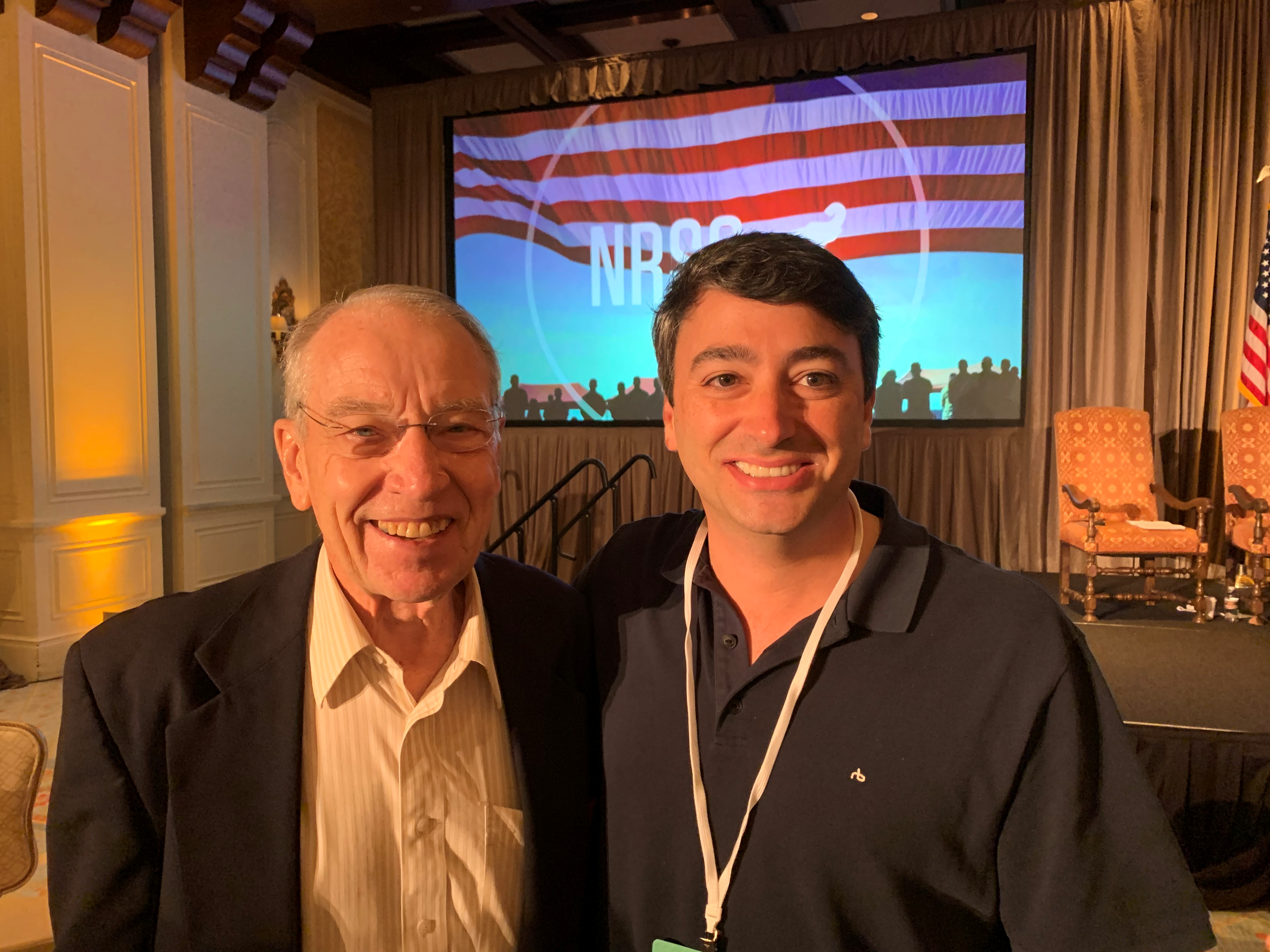
NeurosurgeryPAC vice-chair, Stephen S. Scibelli, MD, FAANS, with Senate Finance Committee Chair, Chuck Grassley (R-Iowa)
Communications Outreach
Beyond its direct lobbying and grassroots advocacy, the Washington Committee garners support for neurosurgery’s health policy positions by carrying out a nationwide earned media campaign and by providing the media with timely information that can be used for their reporting. The Washington Office’s traditional media/communication efforts include Op-Eds, letters to the editor and briefings with reporters. In addition, the Washington Office’s digital media platforms continue to see significant expansion and have amassed a subscription audience of more than 130,000. These communication tools include:

AANS past-president, Alex B. Valadka, MD, FAANS, and AANS/CNS Washington Committee chair, Ann R. Stroink, MD, FAANS, in Washington, DC attending the Alliance of Specialty Medicine’s annual legislative conference
- Neurosurgery Blog: More Than Brain Surgery, a web-based opinion and perspective column, through which the AANS offers insights and perspective on contemporary health issues as they relate to organized neurosurgery.
- Various social media platforms used to gain greater visibility for neurosurgery’s advocacy efforts, including Twitter, Facebook, Instagram, LinkedIn and YouTube.
The AANS voice is also amplified through our participation in coalitions, including the Alliance of Specialty Medicine — whose spokesperson is AANS Past-President, Alex B. Valadka, MD, FAANS — and the Surgical Care Coalition.